Maintaining Mental Engagement During Repetitive Training Exercises
Understanding the Psychology Behind Repetitive Training
Picture this: you’re working with a promising young horse on basic collection exercises, and after the third repetition, you feel their attention drift away like morning fog in the Ridgecrest desert. Their movements become mechanical, their ears stop tracking your cues, and suddenly what started as productive training becomes a frustrating dance with a mentally absent partner.
This scenario plays out in training arenas across the country every day, but understanding why horses mentally check out during repetitive work isn’t just about improving performance—it’s about building the kind of trust-based partnership that creates exceptional horses and riders.
Why Horses Tune Out During Monotonous Sessions
Horses are naturally curious, intelligent animals designed to process constantly changing environmental stimuli. When we ask them to repeat the same exercise over and over without variation, we’re essentially asking their brains to operate against their evolutionary programming. Think of it like forcing yourself to count backward from 1,000 by threes while someone reads you the phone book—your mind will find ways to escape.
The equine brain processes information differently than ours. While humans can understand the long-term goal of repetitive practice (building muscle memory, refining technique), horses live in the immediate moment. Without clear, engaging communication about why they’re doing something repeatedly, they’ll naturally seek mental stimulation elsewhere. This might look like suddenly spooking at familiar objects, developing resistance to previously accepted cues, or simply going through the motions without genuine engagement.
Physical discomfort often compounds mental disengagement. Repetitive exercises without adequate variation can create soreness in specific muscle groups, leading horses to associate the work with discomfort rather than accomplishment. When training becomes something to endure rather than enjoy, we’ve lost the most powerful tool in our arsenal: willing partnership.
The Science of Equine Learning and Attention Spans
Research indicates that horses maintain optimal attention for focused work sessions of roughly 15-20 minutes before their concentration begins to wane. However, this doesn’t mean they can only work for 20 minutes total—rather, they need mental breaks or changes in activity to reset their focus. Their brains require time to process and consolidate new information, much like students need breaks between intensive study sessions.
The equine learning process involves creating neural pathways through repetition, but these pathways strengthen more effectively when the repetition includes subtle variations that keep the mind engaged. Therapeutic horsemanship programs often demonstrate this principle beautifully, as working with diverse riders naturally creates variation within consistent exercises.
Memory consolidation in horses happens during periods of rest and reflection, not just during active training. This explains why horses often perform better the day after a challenging session—their brains have had time to process and organize the information. Pushing through mental fatigue rarely produces lasting positive results.
Recognizing Early Warning Signs of Mental Disengagement
The first signs of mental checkout are often subtle: ears that stop moving toward you during instruction, eyes that begin scanning the environment instead of focusing on the task, or a slight delay in response to familiar cues. Experienced trainers learn to read these micro-expressions like a roadmap to their horse’s internal state.
Physical signs follow quickly behind mental disengagement. You might notice stiffness in movements that were previously fluid, resistance to forward momentum, or the horse beginning to lean on aids rather than responding to them. Some horses become increasingly fidgety, while others adopt a resigned, mechanical quality to their work.
Behavioral changes can manifest as increased spookiness, reluctance to enter the training area, or developing negative associations with specific exercises. A horse that once approached training with eager anticipation might suddenly need extra encouragement just to begin working. These changes signal that the training approach needs immediate adjustment.
How Boredom Affects Performance and Safety
Mental disengagement creates a cascade of problems that extend far beyond poor performance. A bored, inattentive horse becomes unpredictable, potentially dangerous to both rider and handler. Their natural flight response becomes heightened because they’re no longer focused on their partner but instead scanning for external threats or stimulation.
Performance deteriorates in measurable ways when horses lose mental engagement. Movements lose precision, timing becomes inconsistent, and the horse may begin anticipating or rushing through exercises just to get them over with. This creates poor muscle memory and actually sets back training progress rather than advancing it.
The safety implications cannot be overstated. An inattentive horse might not notice ground hazards, could react explosively to minor distractions, or fail to respond appropriately to emergency cues. Building consistent communication and maintaining mental engagement isn’t just about achieving training goals—it’s about creating a reliable, safe partnership that serves both horse and rider throughout their working relationship.
Strategic Variation Techniques for Essential Exercises
Micro-Adjustments That Transform Basic Movements
The magic of maintaining engagement lies in the subtlest modifications to familiar exercises. Rather than abandoning proven techniques, professional trainers create fresh challenges through micro-adjustments that horses barely notice at first but that completely transform their mental approach to the work.
Consider the simple halt transition. Instead of always asking for a square halt, introduce variations: halt with a slight bend to the left, then the right. Ask for a halt that settles into a natural stance rather than forcing perfect squareness. These tiny changes require the horse to think rather than simply go through automated motions.
Timing adjustments prove equally powerful. If your horse anticipates the canter transition after eight trot strides, vary it to six, then twelve, then four. This unpredictability keeps their mind actively engaged with your aids rather than falling into predictable patterns. The key is maintaining the same quality of response while shifting the timing parameters.
Even basic ground work benefits from micro-variations. Change your position slightly when asking for backing up, or introduce a pause mid-movement before continuing. These small modifications preserve the exercise’s training value while preventing the mental checkout that kills progress.
Environmental Changes to Refresh Familiar Patterns
Your training environment shapes your horse’s mental state more than most riders realize. The same arena corner where you always practice leg yields becomes a trigger for autopilot behavior. Strategic environmental shifts break these location-based habits without compromising the exercise’s foundation.
Move familiar exercises to different areas of your arena or property. Practice your usual lateral work patterns along the fence line instead of down the center. Take basic exercises outdoors when weather permits, or shift from the main arena to a smaller space that requires more precise aids and attention.
Incorporating props creates instant mental engagement without complex planning. A single ground pole transforms ordinary circles into exercises requiring visual focus and careful footwork. Traffic cones scattered throughout your space give you reference points for riding figures that demand active steering rather than following worn arena tracks.
Weather changes offer natural variation opportunities. Light rain creates different footing that requires your horse to pay attention to balance and placement. Working in Ridgecrest’s variable conditions teaches horses to adapt their movement patterns based on environmental feedback rather than relying solely on muscle memory.
Incorporating Ground Work Between Mounted Sessions
Strategic ground work breaks create mental reset points that prevent the glazed-over expression that signals checked-out horses. These sessions don’t need to be lengthy or complex, just different enough to reactivate your horse’s thinking processes.
A five-minute leading exercise with changes of direction and pace shifts the horse’s focus from “enduring” repetitive mounted work to actively responding to your body language. Simple backing exercises or asking for lateral steps from the ground engages different muscle groups while maintaining the training session’s momentum.
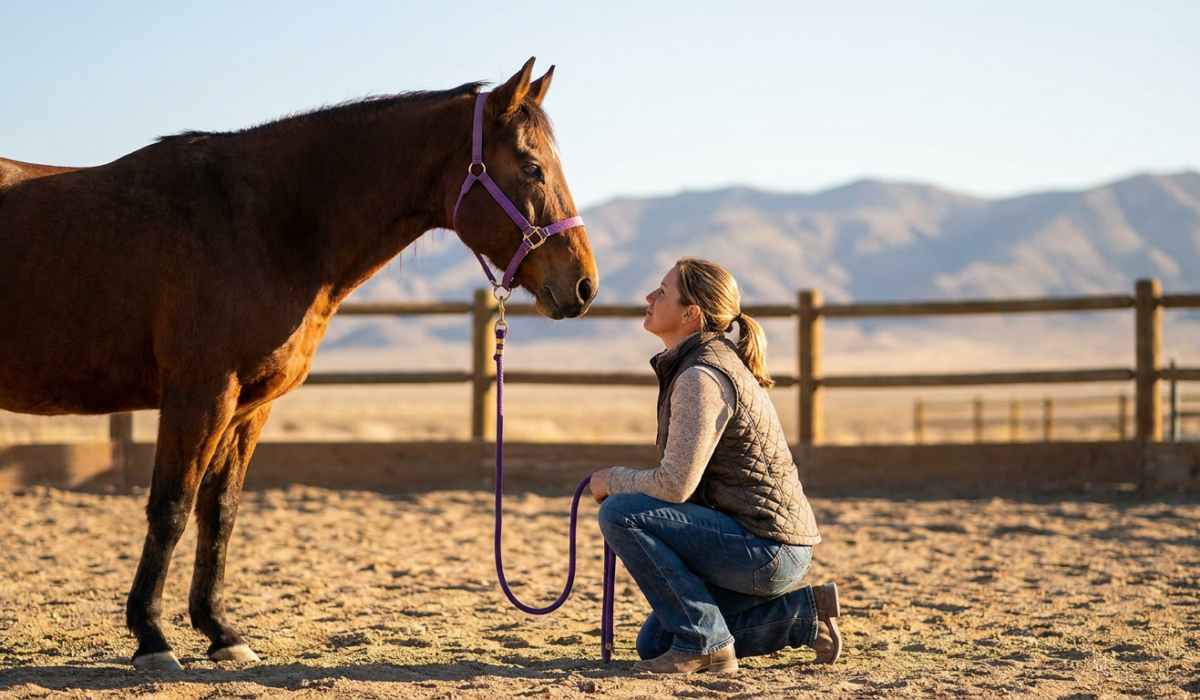
Liberty work, even in small spaces, creates powerful mental engagement shifts. Asking your horse to follow you freely for just a few minutes rebuilds the partnership dynamic that repetitive exercises sometimes erode. This approach aligns with therapeutic horsemanship principles by emphasizing communication over coercion throughout the training process.
Ground work also provides assessment opportunities. How your horse responds to familiar requests from the ground often reveals mental fatigue before it becomes obvious under saddle. This awareness helps you adjust the session’s intensity before reaching the point of diminishing returns.
Timing Intervals for Maximum Retention
Understanding optimal work intervals prevents the mental shutdown that destroys training effectiveness. Most horses maintain peak attention for specific timeframes that vary based on the exercise’s complexity and the individual animal’s capacity.
For basic repetitive exercises, work in three to five-minute segments with deliberate breaks. These breaks don’t mean standing idle, but shifting to different movements that use the same muscle groups in varied ways. This technique maintains physical conditioning while providing mental relief from monotonous patterns.
Progressive trainers recognize that quality repetitions trump quantity every time. Ten engaged repetitions create more lasting progress than twenty mindless ones. Watch for subtle signs of mental fatigue: delayed responses, inconsistent rhythm, or that distant look that indicates your horse has mentally left the building.
Advanced horses might handle longer work periods, but they also require more sophisticated variation within those periods. These experienced animals often benefit from structured progression systems that layer complexity gradually rather than simply extending duration.
The most successful training programs build rest and variation into their fundamental structure rather than treating them as afterthoughts. This proactive approach prevents mental staleness before it develops, maintaining the positive energy that creates breakthrough moments rather than grinding through sessions that diminish both horse and rider enthusiasm.
Building Progressive Challenge Systems
Creating Natural Difficulty Progressions
The key to maintaining mental engagement during repetitive exercises lies in creating systematic progressions that feel natural to your horse. Rather than jumping from basic movements to complex maneuvers, successful trainers build bridges between skill levels using incremental challenges.
Start with your horse’s current comfort zone and add one variable at a time. If you’re working on ground exercises, begin with basic leading at a steady pace. Once that becomes automatic, introduce direction changes every few strides. Next, add elevation changes using poles or small obstacles. This methodical approach keeps your horse thinking without overwhelming their processing capacity.
Professional trainers often use the “80-20 rule” during progressive training sessions. Approximately 80% of the work should feel familiar and achievable, while 20% introduces new challenges. This balance maintains confidence while preventing boredom. When working with therapeutic programs, this ratio becomes even more critical as both horse and rider develop trust through consistent success.
Using Equipment and Props to Add Interest
Strategic use of props transforms routine exercises into engaging puzzles that require mental focus. Cavaletti poles, cones, and ground obstacles serve as more than physical challenges – they create visual stimuli that demand attention and problem-solving.
Introduce props gradually, allowing your horse to investigate and understand each new element. A simple cone placement exercise can evolve into complex patterns that require memory, spatial awareness, and precise movement. The desert environment around Ridgecrest provides natural obstacles too – rocks, small hills, and varied terrain that can supplement arena work.
Rotate equipment regularly to prevent habituation. What challenges your horse today should change tomorrow, even if the underlying skill remains the same. This approach keeps sessions fresh while reinforcing fundamental behaviors. Props also provide clear visual markers for both horse and handler, making communication more precise and reducing confusion during repetitive work.
Developing Horse-Specific Motivation Strategies
Every horse responds differently to mental challenges, making individual motivation strategies essential for sustained engagement. Some horses thrive on problem-solving complexity, while others prefer consistent patterns with subtle variations. Understanding your horse’s personality drives effective training decisions.
High-energy horses often benefit from physical challenges integrated into mental work. These horses might excel at exercises requiring quick decision-making and dynamic movement patterns. Conversely, calmer horses might prefer methodical, puzzle-based challenges that reward patience and careful thinking.
Observe your horse’s body language during different types of mental engagement. Ears forward and relaxed movement indicate positive interest. Tension, resistance, or checking out mentally suggests the current approach isn’t matching their learning style. Successful trainers adjust their methods based on these subtle feedback signals rather than forcing predetermined programs.
Timing becomes crucial with motivation strategies. Some horses work best with short, intensive mental sessions followed by physical release. Others maintain focus longer when mental challenges are woven throughout physical work. This individual approach requires patience but creates stronger partnerships and more sustainable training progress.
Balancing Repetition with Innovation
The art of horse training mental engagement requires finding the sweet spot between necessary repetition and stimulating innovation. Too much repetition creates mental shutdown, while excessive novelty can overwhelm and create anxiety.
Establish core exercises that form the foundation of your training program, then vary the context rather than the movement itself. A basic halt-walk transition might occur at different locations in the arena, with varying duration holds, or incorporated into larger movement patterns. The horse practices the same skill while their brain processes new environmental information.
Advanced trainers often use “sandwich” training sessions. Begin with familiar, confidence-building work, introduce new challenges in the middle when focus is peak, then return to comfortable exercises for a positive ending. This structure maintains engagement while ensuring sessions end on successful notes.
Consider seasonal variations that reflect natural behavioral patterns. Horses naturally become more alert and energetic during certain times of year. In Ridgecrest’s changing seasons, you can adjust your innovation levels accordingly – perhaps introducing more complex challenges during cooler months when horses are naturally more focused, while simplifying during extreme heat when concentration becomes more difficult.
Document what works for each horse in your program. Patterns emerge over time that help predict which innovations will engage specific personalities. This systematic approach transforms intuitive training decisions into replicable methods that consistently produce positive results.
Reading Your Horse’s Mental State
Body Language Indicators of Engagement Levels
Your horse’s ears tell the story. Forward, alert ears signal active mental engagement, while pinned or constantly swiveling ears often indicate frustration or overstimulation. But ears are just the beginning. Watch for the subtle head position changes that reveal true mental state.
An engaged horse maintains soft, focused eyes with regular blinking patterns. Glazed or half-closed eyes during repetitive exercises signal mental checkout, while overly wide eyes suggest stress or confusion. The mouth provides additional clues through relaxed jaw movement and occasional licking or chewing, which indicates processing and acceptance of the work.
Body posture speaks volumes about mental engagement. A horse actively participating in training maintains balanced weight distribution and responsive muscle tone. Contrast this with the horse that’s mentally checked out, often showing heavy forehand, dragging feet, or mechanical movement patterns without the subtle adjustments that indicate thinking.
Tail position and movement offer another layer of insight. A gently swinging tail suggests relaxed engagement, while a clamped tail indicates tension or resistance. Excessive tail swishing during repetitive work often signals frustration rather than physical discomfort, particularly when it appears rhythmically with specific exercises.
Distinguishing Between Physical and Mental Fatigue
Physical fatigue manifests in obvious ways through heavy breathing, increased sweating, and visible muscle tension. Mental fatigue, however, presents more subtly but proves equally important for maintaining quality training sessions. Understanding this distinction becomes crucial for professional trainers working with horses daily.
Mental fatigue often appears as delayed responses to familiar cues, even when the horse shows no physical distress. The horse that normally responds immediately to leg pressure might take an extra beat to react, not from disobedience but from cognitive overload. This delay pattern typically emerges before physical tiredness becomes apparent.
Behavioral changes provide clear indicators of mental fatigue. Horses experiencing cognitive exhaustion often become either overly compliant (going through motions without engagement) or increasingly resistant to simple requests. They might perform complex movements perfectly but struggle with basic transitions that require mental processing.
Environmental awareness shifts dramatically with mental fatigue. A mentally fresh horse notices birds, other horses, or unusual sounds while maintaining focus on work. The mentally tired horse either becomes hyperfocused on the task (tunnel vision) or completely distracted by external stimuli, losing the balanced awareness that indicates healthy engagement.
Adapting Training Intensity Based on Daily Assessment
Daily assessment begins before you even approach your horse. Notice their behavior in the paddock or stall. Is your horse alert and interested in your approach, or do they seem withdrawn? These initial observations guide your entire session strategy rather than forcing predetermined training plans.
Weather conditions in Ridgecrest significantly impact mental state assessment. Hot desert days naturally decrease mental stamina, requiring shorter, more focused sessions with frequent breaks. Cooler mornings often provide optimal conditions for challenging mental work, while windy days might call for simpler, confidence-building exercises.
Adjust exercise complexity based on your horse’s demonstrated mental capacity that day. A horse showing sharp, eager responses can handle novel challenges or precision work. When responses seem sluggish or mechanical, return to familiar exercises with slight variations rather than introducing completely new concepts.
Time intervals between exercises become crucial adaptation tools. Some horses need immediate transition to maintain engagement, while others require processing time between requests. Professional therapeutic horsemanship often employs extended pause periods to allow mental integration, particularly beneficial for horses showing signs of cognitive overload.
When to Push Through vs. When to Pivot
Recognizing breakthrough moments separates skilled trainers from novices. Sometimes apparent resistance actually signals the horse working through a challenging concept. True learning often involves momentary confusion before understanding emerges. The key lies in distinguishing productive struggle from genuine overwhelm.
Push through when you observe active problem-solving behaviors such as ear positioning changes, weight shifts, or experimental movements. These indicate mental engagement despite apparent difficulty. The horse trying different approaches to understand your request demonstrates healthy cognitive processing worth supporting through consistent pressure and clear communication.
Pivot immediately when you notice shutdown behaviors such as complete stillness, mechanical repetition without variation, or escalating resistance patterns. These signals indicate the horse has exceeded their mental capacity for that session. Continuing often creates negative associations that require extensive rebuilding later.
End sessions on positive notes by recognizing small improvements rather than demanding perfect execution. A horse that shows slight improvement in timing, balance, or responsiveness has made genuine progress worth celebrating. This approach builds confidence and enthusiasm for future training sessions while maintaining the mental engagement essential for long-term development.
Advanced Engagement Strategies for Different Disciplines
Dressage-Specific Mental Stimulation Techniques
Dressage demands precision and repetition, but maintaining your horse’s mental engagement requires strategic variety within the discipline’s structured framework. Rather than drilling the same movement repeatedly, break down complex maneuvers into component parts and reassemble them in different sequences.
Start your sessions with lateral work variations. If you’re working on shoulder-in, alternate between performing it down the long side, on a circle, and transitioning in and out of it every few steps. This approach keeps your horse thinking about the aid rather than anticipating the pattern. The mental challenge becomes interpreting your subtle changes in pressure and timing, not just following a predetermined track.
Temperature changes within movements create fresh engagement. Practice your half-halts at different speeds within each gait, asking for collection and extension within the same exercise. Your horse learns to respond to your energy shifts, maintaining focus on your communication rather than falling into automatic responses.
Incorporate ground poles and cavaletti into your flatwork sessions. Even advanced horses benefit from the visual and physical coordination required to maintain their movement quality while navigating obstacles. This simple addition transforms routine exercises into problem-solving activities.
Keeping Jumping Horses Sharp Through Gridwork Variations
Gridwork often becomes monotonous when trainers stick to standard distances and heights. Advanced engagement requires constant micro-adjustments that challenge your horse’s athletic problem-solving abilities without creating confusion or stress.
Modify distances by just six inches between sessions. Your horse must recalibrate their stride length and takeoff timing, maintaining active thinking throughout the exercise. Start with comfortable distances, then gradually compress or extend them to develop adjustability and mental flexibility.
Change the grid’s visual presentation frequently. Use different jump materials, colors, and fillers within the same exercise structure. Professional trainers understand that horses become desensitized to familiar visuals, so rotating your equipment maintains alertness and prevents careless jumping habits.
Direction changes within gridwork sessions prevent pattern anticipation. Approach your grids from both directions, and consider angled entries that require your horse to think about their line and balance differently. The approach to therapeutic horsemanship often emphasizes this type of adaptive thinking, building confidence through varied but manageable challenges.
Trail and Working Horse Mental Conditioning
Working horses face unique mental engagement challenges because their jobs often involve repetitive tasks in familiar environments. Creating variety within practical work maintains sharpness without compromising efficiency.
Route variation becomes your primary tool for mental stimulation. Even when checking the same pastures or covering familiar ground, alternate your paths and vary your pace. Stop periodically for ground exercises, asking your horse to move their hindquarters or shoulders while maintaining position. These brief training moments break up routine travel and keep your horse responsive to your cues.
Introduce obstacle challenges along familiar trails. Carry small jumps or poles that can be set up temporarily, creating impromptu training opportunities. Your horse learns to expect the unexpected, maintaining alertness throughout longer rides.
Weather and terrain changes naturally provide mental stimulation, but you can enhance these challenges through your riding approach. Navigate the same trail differently in wet conditions, taking wider turns or choosing alternate footing. Your horse develops confidence and problem-solving skills while accomplishing practical work.
Competition Preparation Without Burnout
Competition training creates unique pressure for maintaining engagement while building muscle memory through repetition. The key lies in strategic intensity cycling that prevents mental fatigue while developing consistent performance.
Structure your training weeks around varying intensity levels rather than maintaining constant pressure. Follow two demanding sessions with a lighter day focused on relationship building and basic exercises. This pattern allows mental recovery while maintaining physical conditioning and technical progress.
Simulate competition conditions gradually rather than creating sudden environmental changes. Practice your routine in different arenas, with varying noise levels and distractions. Start with minor changes and progressively increase complexity, allowing your horse to develop confidence in their abilities across different settings.
Cross-training between disciplines prevents specialization burnout. Even dedicated dressage horses benefit from occasional trail rides or light jumping sessions. These activities use different muscle groups and mental processes, providing recovery while maintaining fitness and enthusiasm for their primary discipline.
Monitor your horse’s enthusiasm levels daily. Engaged horses show curiosity about their work environment and respond promptly to your preparation routines. When you notice decreased interest or resistance to familiar exercises, immediately scale back intensity and introduce novelty rather than pushing through mental fatigue.
Long-Term Training Program Design
Weekly Schedule Planning for Sustained Interest
Smart trainers design weekly schedules that balance repetitive exercises with strategic breaks. Monday might focus on groundwork fundamentals, Tuesday on mounted repetition, Wednesday on liberty work variations, Thursday returning to core exercises with subtle modifications, and Friday dedicated to review sessions. This rhythm prevents horses from anticipating identical routines while maintaining consistent practice of essential skills.
The key lies in creating what professional trainers call “structured flexibility.” Your horse needs to practice those foundational movements repeatedly, but the timing and sequence can shift dramatically. Start Tuesday’s session with lateral work instead of forward movement, or incorporate brief trail simulation breaks between arena exercises. These small changes maintain mental freshness without compromising technical development.
Building rest days into weekly schedules becomes crucial for horses prone to mental fatigue. Some horses thrive on six-day training weeks with varied intensity, while others require alternating heavy and light days. Observing your horse’s energy patterns over several weeks reveals their optimal schedule for maintaining engagement during necessary repetitive work.
Seasonal Training Cycles and Mental Recovery
Successful long-term programs mirror natural seasonal rhythms that horses instinctively understand. Winter months in Ridgecrest often provide opportunities for intensive indoor work on repetitive exercises, while spring and summer allow for trail integration and outdoor variety. This natural ebb and flow prevents the mental staleness that develops when horses face identical routines year-round.
Professional trainers build “mental recovery phases” into their annual programs, typically lasting 2-3 weeks where repetitive exercises become secondary to exploration and play. These periods might involve trail riding, liberty work in new environments, or simple ground play sessions. The horses return to structured training with renewed enthusiasm for familiar exercises.
Planning these cycles requires honest assessment of both horse and trainer energy levels. Many successful programs include quarterly intensity reviews, adjusting the balance between repetitive skill-building and creative exploration based on progress and engagement levels observed throughout the previous months.
Tracking Progress While Maintaining Engagement
Effective tracking systems capture both technical progress and mental engagement indicators. Simple daily notes recording energy level, willingness, and focus quality provide valuable data for adjusting training approaches. When repetitive exercises start showing declining engagement scores, it’s time for tactical changes rather than pushing through resistance.
Video documentation proves invaluable for tracking subtle improvements in repetitive movements while identifying early signs of mental fatigue. Weekly review sessions help trainers spot patterns: perhaps engagement drops consistently on Thursdays, suggesting the need for mid-week variety, or certain exercises maintain interest longer than others.
Creating visual progress markers helps both horse and trainer celebrate incremental improvements. Simple goals like “maintaining soft contact for 10 consecutive circles” or “three smooth transitions without resistance” give meaning to repetitive work. These small victories sustain motivation through challenging training phases while building toward larger objectives.
Building Resilience for Future Training Challenges
Horses developed through thoughtful repetitive training programs demonstrate remarkable resilience when facing new challenges. They’ve learned that consistent work leads to positive outcomes, creating mental frameworks for approaching unfamiliar exercises with confidence rather than anxiety.
This resilience emerges from positive associations built during countless repetitions of basic exercises. When horses experience success through patient, engaging practice of foundational skills, they develop trust in the training process itself. That trust transfers to advanced work, therapeutic applications, and even challenging situations outside the arena.
Professional facilities understand that today’s repetitive training builds tomorrow’s confident horses. Programs incorporating strategic engagement techniques during fundamental skill development create horses capable of handling complex tasks, therapeutic work, and varied riding disciplines throughout their careers.
The investment in maintaining mental engagement during repetitive exercises pays dividends across every aspect of horse development. Rather than viewing repetition as boring necessity, skilled trainers recognize it as opportunity for building deep partnerships and unshakeable foundations. Whether you’re developing a young horse or refining advanced skills, thoughtful approaches to therapeutic horsemanship programs demonstrate how patient, engaging repetition creates horses ready for any challenge life presents.
Related Posts
- Candee Coffee: Five Decades of Horsemanship in Ridgecrest
- More Than Riding Lessons: C and C Training Stables as a Community Oasis
- Riding Into Inclusivity: Youth Programs and Therapeutic Horsemanship at C and C Training Stables
- Behind the Barn Doors: A Day in the Life at C and C Training Stables
- The Lasting Legacy of C and C Training Stables in Ridgecrest
- Getting Your Horse Ready for Spring Riding Season in Ridgecrest
- Spring Training Tips That Actually Work for New Riders
- Why March is Perfect for Starting Horse Riding Lessons