Advanced Liberty Work Techniques for Enhanced Connection This July
Understanding the Foundation of Liberty Connection
Ever watched a pair of horses in a wide-open pasture, moving together with an almost telepathic synchronicity? That effortless flow, the subtle cues, the undeniable partnership—that’s what we’re aiming for with advanced liberty work. It’s more than just getting your horse to follow; it’s about delving into a deeper understanding, forging a connection where communication becomes a dance, not a command. For those of us passionate about horse training and horse riding, this means moving beyond the basics and truly understanding the nuances of our equine partners.
Liberty training, especially at an advanced level, isn’t just a set of physical exercises; it’s a mental game for both horse and human. It requires patience, keen observation, and a willingness to understand the world from your horse’s perspective. When both partners are engaged, truly listening to each other, that’s when the magic happens. This July, let’s explore how to deepen that bond and elevate your liberty work.
Reassessing Your Horse’s Current Liberty Skills
Before diving into advanced techniques, a solid foundation is non-negotiable. Think of it like building a house; you wouldn’t put up the roof before the walls are stable, right? The same goes for your horse’s liberty skills.
Take an honest look at where you both stand. Can your horse maintain a consistent pace and direction without a lead rope in a familiar environment? Does he confidently respond to your body language for simple transitions like walk-trot-halt?
Assessing their current skill level isn’t about judgment; it’s about identifying strengths and areas that might need a little more polish before adding complexity. Are they easily distracted? Do they understand your stop cue consistently from a distance?
Are they comfortable being sent away from you and then called back? These foundational elements, often overlooked, are the building blocks for anything more intricate.
It’s important to remember that progress isn’t always linear. Some days, a horse might pick up a new concept almost instantly, while others require consistent, patient repetition. Just like people, horses have good days and bad days, and recognizing this is part of becoming a good trainer.
This assessment helps us tailor our approach, ensuring that we’re always setting our horses up for success, not frustration. After all, the goal is to enhance the connection, not strain it.
The Equine Perspective: Reading Subtle Cues and Body Language
To truly advance in liberty work, you have to become a student of equine communication. Horses talk all the time, not with words, but with their entire being. Their ears, eyes, nostrils, head carriage, tail swish, and even the tension in their muscles—all provide a rich tapestry of information.
Can you tell the difference between a horse that’s interested and one that’s apprehensive? Can you read the subtle shift in their weight that indicates they’re about to move, even before they do?
Understanding these subtle cues is paramount. It allows you to respond proactively, not reactively. For instance, if you notice your horse’s ears flicking back and forth rapidly, or their eyes darting, it might be a sign of environmental stress, telling you to adjust your approach or perhaps change the training location.
If their lower lip is relaxed and their breathing is calm, they’re likely engaged and receptive. This kind of communication isn’t just about reading your horse’s emotional state; it’s also about predicting their next move during exercises.
Many of the successful trainers we’ve seen, like Candee Coffee, whose dedication for “Candee Coffee: Five Decades of Horsemanship in Ridgecrest” has shaped so many riders, possess an uncanny ability to read horses. It’s an art developed over countless hours of observation. This skill isn’t innate for everyone, but it can absolutely be honed through focused attention and practice.
The more you observe, the more intuitive you become, and the stronger your non-verbal dialogue with your horse will be. This deep understanding also fosters the trust needed to achieve advanced harmony.
Building Trust Beyond Basic Obedience
Trust is the bedrock of all successful horse training. In liberty work, however, it takes on an even greater significance. Without the physical restraint of a lead rope or reins, your horse chooses to be with you, to engage with you, and to respond to your requests. This isn’t just about obedience; it’s about a willing partnership born from mutual respect and confidence.
Basic obedience might get a horse to stop on command, but advanced trust is what inspires them to stop when you simply think the halt, or to stay calmly by your side in an unfamiliar environment. This trust is built through consistency, clear communication, and ensuring safety above all else. It’s about being fair, predictable, and never asking for more than your horse is emotionally or physically ready to give. Every positive interaction, every correctly interpreted cue, every moment you honor their “no” before it becomes a “yes,” adds another layer to that trust.
Consider the environment at C and C Training Stables in Ridgecrest. Our community oasis approach often emphasizes building relationships, not just perfecting techniques. This principle extends directly to liberty work. When your horse truly trusts you, they’ll offer behaviors willingly, sometimes even anticipating your desires before you fully express them. This is the stage where horse training becomes less about instruction and more about a profound, shared experience.
The Role of Environment in Successful Liberty Training
The space where you conduct your liberty training plays a much larger role than many realize. For initial, basic liberty work, a smaller, enclosed area like a round pen is often ideal because it naturally encourages the horse to stay within reach and limits distractions. As you progress to advanced liberty work, however, you’ll want to gradually expand your training environment.
Moving from a round pen to a larger arena, and then perhaps to an open field, introduces varying levels of distraction and freedom. This progression is crucial for solidifying your horse’s understanding and proving the strength of your connection. A horse that performs beautifully in a round pen might become scattered in a large open space, not because they don’t understand the cues, but because the environment presents too many novel stimuli or escape routes.
The environment tests the genuine nature of their engagement and trust. In Ridgecrest, we have diverse areas that can be utilized for this progression.
Always consider the safety of the environment. Ensure the ground is even, free of hazards, and that there are no unexpected elements that could startle your horse. A calm and secure setting allows your horse to focus on you, rather than constantly assessing potential threats. Gradually introducing new environments, starting with those that offer minimal distractions and slowly increasing the complexity, builds confidence in both you and your horse, reinforcing that your partnership is stable regardless of the surroundings. This thoughtful approach to environmental control underpins all successful advanced liberty work, just as it does in most comprehensive horse training techniques.
Refining Communication Through Advanced Liberty Drills
Once you’ve established those foundational bonds in liberty work, the real fun begins: refining your communication to a level that feels almost telepathic. This isn’t just about getting your horse to do specific behaviors; it’s about making those behaviors seamless, fluid, and a true partnership. This July, let’s explore how advanced liberty work can deepen that connection.
We’re talking about moving beyond simple cues to creating a dialogue where both you and your horse anticipate each other’s intent. It requires a dedicated approach that goes beyond the basic round pen exercises. Trainers who truly excel at advanced liberty work understand that every subtle shift in their body language, every breath, and every mental image they create impacts their horse. It’s a beautiful dance, don’t you agree?
Introducing Complex Patterns and Transitions
Moving into advanced patterns at liberty requires your horse to not just understand individual cues, but to link them together in a meaningful sequence. Think about teaching your horse to weave through cones, perform flying lead changes on a curve, or execute a perfect figure-eight, all without a rope or halter. This isn’t just about physical execution; it’s a significant mental exercise for both of you.
We start by breaking down these complex exercises into smaller, manageable steps. Initially, you might use your body position and a clearer, perhaps larger, spatial cue to guide them through a simple turn. As they grasp that, you gradually introduce more elements, like a stop mid-pattern, then a pivot, then a canter departure. The key is consistent repetition and always ending on a positive note. We want them to feel like they’ve solved a puzzle, not been drilled.
Transitions are where true finesse shines. Can your horse shift from a collected trot to an energetic canter, then down to a walk, all with your subtle mental command and barely perceptible body cues? This level of responsiveness comes from thousands of repetitions where your intent is clear, your timing precise, and your horse’s reward for successful completion is consistent. It creates a seamless flow, a conversation without words, really.
Developing True Impulsion and Engagement at Liberty
Impulsion at liberty isn’t about chasing your horse; it’s about inspiring them to move with purpose, energy, and engagement, rather than mere compliance. We want that spark, that forward motion that comes from within. How do we cultivate that? It starts with really understanding your horse’s natural energy levels and then learning to enhance them without creating undo pressure.
One technique we use involves teaching the horse to “offer” energy. Rather than always asking for more speed with a driving cue, we might momentarily soften our body language, allowing them a moment of rest, then subtly shift our weight or gaze to see if they offer a faster pace or a more engaged stride on their own. When they do, even for a step, that’s what we reward. This builds a horse that chooses to move with you, not one that feels pushed.
Engagement also means they’re not just running around you, but truly connected to your focus. When you change direction, do they anticipate it? Do their ears swivel towards you?
Are their eyes soft but attentive? True impulsion at liberty is a sign of a horse that’s not only physically moving but also mentally present and wanting to participate in the activity with you. It’s a testament to the trust and communication you’ve built.
Teaching Distance Control and Independent Maneuvers
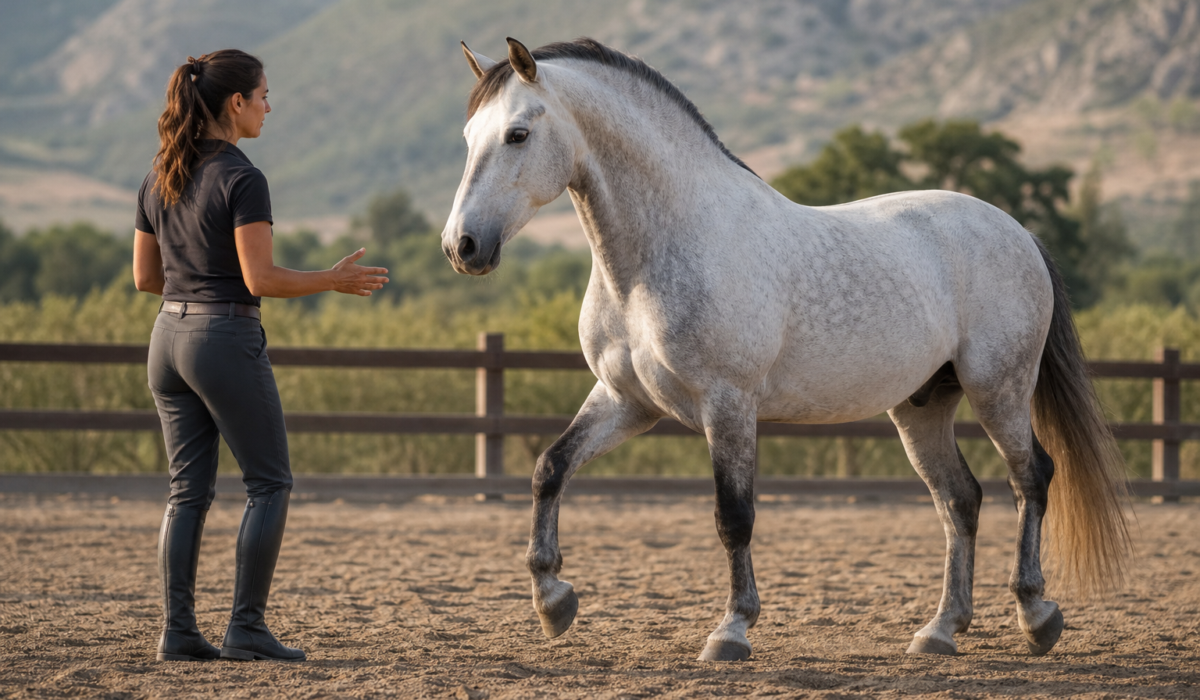
Advanced liberty work often progresses to controlling your horse at increasing distances, sometimes even across an arena. This moves beyond the immediate proximity of the round pen and requires even more refined communication. Initially, you might work with a longer lead line that mimics liberty, slowly increasing the distance until the line becomes irrelevant.
The goal is for your horse to understand and respond to your body language and vocal cues from far away. A specific forward signal from your hand should still translate to forward movement, even if you are meters apart. This practice builds incredible confidence in your horse, knowing they can navigate space and still find connection with you. It’s truly amazing to watch. We often see this developed in youth programs too, as it builds such a strong sense of purpose for both horse and human.
Independent maneuvers take it a step further. Can you send your horse to a specific spot, have them perform a small circle or a halt, and then call them back? This requires the horse to not only understand the cue but to briefly maintain that behavior independently.
It’s like sending a child to fetch something from another room; they understand the task and complete it before returning to you. This is where your communication becomes incredibly precise and their understanding deepens significantly.
Utilizing Obstacles and Novelty for Mental Stimulation
To keep things interesting and continually challenge your horse’s mind, incorporating obstacles and novel elements into liberty sessions is invaluable. This isn’t just about physical agility; it’s about building their problem-solving skills and confidence in new situations. Think about setting up a small jump, a bridge to walk over, or even a tarp to navigate.
When introducing an obstacle, start small and ensure it’s safe. Use your established communication to encourage them to approach, sniff, and eventually interact with the object. Reward any curiosity or small step forward. This helps them learn to trust your judgment when facing something new. It encourages a horse that’s brave and willing to explore, rather than one that shrinks from the unknown.
Novelty also extends to changing environments. While building solid communication in a familiar arena is crucial, occasionally taking your liberty work to a new, safe space can challenge both your horse’s focus and your ability to maintain connection outside your comfort zone. It’s amazing how much more engaged a horse becomes when they’re facing something new, and it truly solidifies your bond. We truly believe in creating a stimulating environment for horses, and you can see this philosophy in a day.
Deepening the Relationship: Emotion and Intent
Cultivating a Shared Focus and Intention
Once you’ve nailed down the basic advanced liberty drills, the real magic of liberty training July begins: building a genuinely shared focus. We’re not just looking for compliance anymore; we’re seeking a horse that’s actively engaged with you, mentally and emotionally. This isn’t about demanding attention, but about creating an environment where your horse chooses to give it freely.
Think about it – in any strong relationship, both parties are tuned into each other, anticipating needs and intentions. So, how do we translate that to our equine partners?
It starts with your own energy and presence. Horses, being incredibly sensitive creatures, pick up on our internal state long before we even realize it ourselves. If you walk into the arena distracted or frustrated, your horse will feel it. Cultivating a calm, clear, and confident intention within yourself is paramount. This allows you to project an invitation to connect, rather than a command. Using subtle body language and consistent cues helps establish this shared intention. It’s like a dance where neither partner is leading aggressively; instead, they move together, each anticipating the next step. This deepens the horse connection techniques beyond mere physical execution. Candee Coffee has always emphasized this intuitive connection forged over five decades, illustrating how crucial shared focus is.
Recognizing and Responding to Your Horse’s Emotional State
True partnership in liberty work requires you to become a master reader of your horse’s emotional landscape. It’s not enough to just see if they’re performing the requested movement; you need to understand the ‘why’ behind their responses. Is their ear slightly pinned, indicating a moment of frustration?
Are their nostrils flared, showing unease? Or are they soft-eyed and relaxed, signaling contentment and engagement? These subtle cues are your roadmap to deepening the relationship.
A horse that’s mentally stimulated and emotionally secure will engage differently than one that’s feeling anxious or bored. Responding appropriately means adjusting your approach in real-time. If you sense hesitation, perhaps you soften your ask a bit, waiting for them to offer the correct behavior before reinforcing it. If they’re showing signs of over-excitement, a quiet moment of stillness might be more beneficial than pushing for another complex exercise. This isn’t about coddling; it’s about intelligent communication. Learning to understand these subtle is a cornerstone of advanced liberty work.
The Art of Asking Versus Telling in Liberty Work
This is where advanced liberty work truly diverges from more traditional obedience-based horse training techniques. We’re moving away from telling our horses what to do and towards asking them to participate. What’s the difference, you might wonder?
It’s all in the pressure and the expectation. Telling implies a demand, often backed by heavier pressure, with little room for error or individual expression. Asking, however, creates an invitation, allowing the horse to choose to engage, which builds a much stronger foundation of trust.
When you ask, you present an idea or a request, then give your horse space and time to process and respond. It involves being patient, clear with your intent, and willing to wait for their answer. This creates a positive feedback loop: the horse feels respected, understands they have agency, and is more likely to willingly offer the desired behaviors. This approach minimizes tension and resistance, fostering a more willing and enthusiastic partner. It’s a key component in any successful therapeutic horsemanship program, encouraging active participation.
Building Mutual Respect and Partnership
Ultimately, all these advanced liberty work techniques converge on one overarching goal: building mutual respect and a true partnership. This isn’t a one-way street where the horse simply obeys; it’s a dynamic relationship where both horse and human understand and respect each other’s boundaries, communication, and emotional needs. Mutual respect means acknowledging your horse’s individual personality, their preferences, and even their off days.
For example, if your horse seems tired during a session, respecting that might mean opting for a shorter, lighter session or even just spending time grooming and bonding. It also means clearly and consistently communicating your expectations without resorting to force or intimidation. When your horse feels heard, understood, and respected, their confidence in you soars. This isn’t just about performing fancy maneuvers in the arena; it’s about creating a profound bond that extends to all aspects of your time together. This deeper connection is what makes c and c where true partnerships blossom.
Troubleshooting Common Liberty Challenges in July
Even with the best intentions and most refined horse training techniques, liberty work can hit a snag. Especially in the thick of summer, with longer days and unique environmental factors, you might find your advanced liberty work facing new hurdles. And let’s be honest, horses are individuals, which means their challenges are unique too.
It’s not about failure; it’s about identifying the problem and adjusting your approach. This July, we’ll look at some common issues and how to navigate them.
Addressing Distractions and Environmental Factors
July in Ridgecrest means heat, sometimes those afternoon winds kicking up dust, and often more activity around the barn. These environmental factors can be huge distractions for both you and your horse during liberty training. A horse might become easily sidetracked by a fly, a strong breeze, or commotion in a nearby pasture.
As trainers, our job is to help them maintain focus. How do we do that without creating more pressure?
First, consider your training environment. Is it possible to train during cooler parts of the day, like early morning or late evening, to minimize heat stress? Can you choose a more secluded area of the property to reduce visual and auditory distractions?
Sometimes, simple changes like these can make a significant difference. If you’re working in an arena, for example, position yourself and your horse to minimize outward distractions. Keep your sessions shorter initially, gradually increasing duration as your horse’s focus improves.
Remember, consistency in your requests and clarity in your communication become even more critical when distractions are present. If a horse is consistently looking away, not responding, or showing signs of discomfort (like tail swishing, head tossing), acknowledge it. That’s not a failure on their part; it’s a cue that you need to adjust either the environment or your expectations for that session.
Building their confidence to ignore external stimuli takes time and a patient approach. And don’t forget to leverage the natural curiosity of horses; sometimes, incorporating a novel, but safe, object into your training can redirect their attention positively.
Overcoming Plateaus and Maintaining Motivation
Every trainer, every horse, hits a plateau. In advanced liberty work, where you’re asking for nuanced movement and behaviors, it’s almost guaranteed. You might find yourselves performing the same exercises repeatedly without noticeable progress, or perhaps your horse’s enthusiasm seems to wane.
This is where creative problem-solving comes in. Are you asking the same way every time? Have you perhaps made the exercises too complex too quickly?
Remember, for horses, variety is the spice of life, too.
One effective technique is to break down advanced maneuvers into even smaller, more manageable steps. If your horse is struggling with a particular sequence, go back a few steps to where they were successful and build confidence there. Introduce new, but simple, exercises to refresh their mental engagement.
This could be something as basic as walking over ground poles at liberty or engaging in some targeting fun. The goal is to keep the intellectual challenge interesting without overwhelming them. For the trainer, maintaining motivation means remembering the progress you’ve already made and celebrating small victories.
If you feel yourself getting frustrated, that energy will communicate directly to your horse. Take a break, come back with a fresh perspective, or try a different exercise. You can also re-evaluate your goals.
Maybe this July, instead of pushing for that perfect spin, you focus on refining the quality of your horse’s trot departe. It’s all about maintaining a positive building process. And sometimes, a fun, no-pressure session where you just let your horse explore and interact with you on their terms can rekindle that spark.
Even something as simple as a structured play session can do wonders.
Managing Energy Levels in Warm Weather
Ridgecrest summers are no joke, and the heat truly impacts both our physical and mental energy levels, and certainly those of our horses. In July, managing energy becomes paramount to successful liberty training. Pushing a horse when they are already feeling the effects of the heat isn’t just unproductive; it can be detrimental to their trust and willingness.
Horses are masters at conserving energy, and you’ll often see subtle changes in their behavior if they’re feeling the heat or are just generally tired. Trainers need to become adept at noticing these subtle changes. Is their head lower?
Are their responses slower? Are they reluctant to engage in more strenuous movement?
Practical steps include adjusting your training schedule to cooler times of the day, as mentioned before. Keep sessions shorter and focused. Hydration is key; ensure your horse has plenty of fresh, cool water before and after your sessions.
Consider the intensity of your exercises. This might not be the month for high-energy, fast-paced liberty work. Instead, focus on slower, more precise movements that require mental engagement rather than intense physical exertion.
Think about refining your communication on subtle cues, or working on groundwork exercises that emphasize connection and responsiveness without demanding a lot of cardio. Sometimes, ending a session on a positive, low-key note – perhaps with a gentle massage or just standing quietly together – can reinforce that positive association, even if the work itself was curtailed due to the heat. Remember, a horse’s health and comfort should always take precedence, especially when the weather is challenging.
When to Seek Professional Guidance
There are times when, despite your best efforts, a particular challenge in liberty training feels insurmountable. Perhaps your horse consistently breaks focus, exhibits a new or concerning behavioral pattern, or you just feel stuck and unsure how to progress. This is not a sign of failure but a wise recognition that an outside perspective can be incredibly valuable.
Just like athletes benefit from coaches, advanced horse training often requires input from experienced trainers. In Ridgecrest, you have resources available. For example, C and C Training Stables has been a fixture in the community for decades, offering professional insights and support across various levels of horsemanship.
Sometimes, all it takes is one session with an experienced eye to pinpoint the root cause of a problem or to offer a fresh perspective on a difficult exercise.
A professional trainer can often identify nuances in your handling, your body language, or your horse’s responses that you might be missing. They can help you refine your pressure and release timing, suggest alternative training methods, or provide specific exercises tailored to your horse’s individual needs. This is especially true for more complex behaviors or if you’re working through training plateaus that have lasted a while. Don’t underestimate the value of someone who has dedicated their life to understanding horses, someone like candee coffee, whose five decades of horsemanship speak volumes. Seeking guidance demonstrates a commitment to your horse’s well-being and your own growth as a trainer. It’s a smart choice that can revitalize your liberty work and deepen your connection, ensuring continued progress and a more harmonious partnership. They might even lead you to insights that transform your entire approach to working with horses, making the entire journey more rewarding.
Integrating Liberty Principles into Everyday Horsemanship
Applying Liberty Lessons to Halter and Lead Work
Once you’ve experienced the profound connection that advanced liberty work can offer, you’ll quickly find yourself looking for ways to integrate those principles into every aspect of your horse training. It’s not just about flashy maneuvers in an arena; it’s about a fundamental shift in how you communicate and build trust. Think about your everyday halter and lead work.
Often, it becomes a routine, a task rather than an interaction. But what if you approached it with the same respect for your horse’s autonomy and willingness that you demonstrate in liberty training? Instead of just pulling your horse along, you might start by inviting them forward, using subtle body cues and focusing on their response.
For example, if your horse is reluctant to lead, a liberty approach would encourage them to move with you because they choose to, not because they’re forced. This might involve stepping slightly in front, inviting them with an open posture, and releasing pressure the instant they take a step forward. This continuous dance of pressure and release, a cornerstone of effective liberty training, translates directly to a lighter, more responsive horse on the lead. You’re building that same mental engagement and positive association. The goal is for the halter and lead to become merely an extension of your communication, rather than a tool of restraint. Riders in Ridgecrest often tell us how much this changes their daily interactions, making them more enjoyable and less of a power struggle.
Enhancing Under-Saddle Communication Through Liberty Foundations
The benefits of advanced liberty work don’t just stay on the ground; they profoundly impact your riding. When you’ve established such a strong, unforced connection at liberty, that understanding carries over into the saddle. How?
Because liberty training emphasizes reading your horse’s subtle physical and emotional cues – the shift of weight, the flicker of an ear, the tension in their body. These are the same nuances that can be harder to detect when you’re perched on their back, but a strong liberty foundation helps you tune into them instinctively.
Consider the concept of “feel” in riding. It’s often elusive for new riders, but liberty techniques build it naturally. You learn to anticipate your horse’s next move, to influence their direction and speed not through brute force, but through your own body language, energy, and intent.
This translates to lighter rein aids, more responsive leg cues, and a horse that is genuinely listening to your suggestions rather than merely reacting to commands. When your horse understands and trusts your intent from the ground, they are far more likely to offer willing cooperation when you’re riding. This advanced level of communication becomes a seamless extension of the bond you’ve forged, creating a harmonious partnership whether you’re walking trails in Ridgecrest or working on more complex maneuvers in the arena.
Promoting Calmness and Cooperation in All Interactions
One of the most valuable outcomes of consistent liberty training, especially the advanced techniques we’ve discussed, is a horse that is inherently calmer and more cooperative in a variety of situations. When horses understand that they have a voice, that their trainers are listening, and that cooperation leads to positive outcomes, their anxiety levels naturally decrease. Think about it: a horse that feels constantly coerced will always be on edge, looking for an escape or a way to resist. Conversely, a horse that is engaged as an active participant in their training process, like those developed through deep liberty work, becomes more secure and confident.
This calmness isn’t just for the training arena. It spills over into every interaction. Trailering, farrier visits, veterinary checks – situations that often create stress for both horse and human can become far less problematic.
Because you’ve built a foundation of trust and clear communication through subtle pressure and release, your horse learns to look to you for guidance and reassurance. They understand that even unfamiliar situations can be navigated safely with you as their leader. This is particularly beneficial for horses in therapeutic horsemanship programs, where a calm, cooperative demeanor is paramount for the safety and well-being of all involved, as we often see in our youth programs here at C and C Training Stables.
The Long-Term Benefits of a Strong Liberty Connection
Investing time and effort into advanced liberty techniques isn’t just about July; it’s about building a lifelong partnership with your horse. The benefits are far-reaching and deeply impactful. You’re not just teaching your horse a set of behaviors; you’re developing their mental and emotional capacity, fostering a deeper bond rooted in mutual respect and understanding.
This enhanced connection means a horse that is more willing, more engaged, and ultimately, a more joyful partner for years to come. Such a partnership is resilient, capable of overcoming challenges and adapting to new situations with greater ease.
Trainers who commit to this approach often find that their horses maintain their physical and mental well-being better throughout their lives. They are less prone to behavioral issues because their communication needs are met, and they have developed a strong emotional connection with their human. This isn’t a quick fix or a trick; it’s a philosophy of horsemanship that enriches both horse and rider.
If you’re ready to experience this level of connection and transform your horsemanship, consider exploring advanced liberty training. The journey is incredibly rewarding, and the bond you forge will be invaluable. We invite you to experience the difference a truly connected partnership can make.
Why not come down to C and C Training Stables in Ridgecrest this July and see how horse riding can deepen your understanding and relationship with your equine companion?
Related Posts
- Candee Coffee: Five Decades of Horsemanship in Ridgecrest
- More Than Riding Lessons: C and C Training Stables as a Community Oasis
- Riding Into Inclusivity: Youth Programs and Therapeutic Horsemanship at C and C Training Stables
- Behind the Barn Doors: A Day in the Life at C and C Training Stables
- The Lasting Legacy of C and C Training Stables in Ridgecrest
- Getting Your Horse Ready for Spring Riding Season in Ridgecrest
- Spring Training Tips That Actually Work for New Riders
- Why March is Perfect for Starting Horse Riding Lessons